
Customer Experience Management: una overview

Customer Experience Management Program Components

Customer Experience Management (CEM) is the process of understanding and managing your customers’ interactions with and perceptions of your company or brand. The ultimate goal of CEM is to build valuable relationship with customers so they stay with you longer, advocate on your behalf and expand their relationship with you over time.

A CEM program consists of a set of organized actions that support the goal of CEM. While a CEM program has many moving parts, an easy way to organize those pieces is depicted in the figure on the right. A CEM program has six major components:

  1. Strategy addresses how companies incorporate CEM into their long-term plans to help achieve its objectives and goals
  2. Governance describes the formal policy around the CEM program: Rules, Roles, Requests
  3. Business Process Integration involves embedding CEM processes/data into other business operations
  4. Method addresses the means by which customer feedback is collected
  5. Reporting addresses analysis, synthesis and dissemination of customer feedback
  6. Research is concerned with how companies provide additional customer insight by conducting deep dive research using different types of customer data
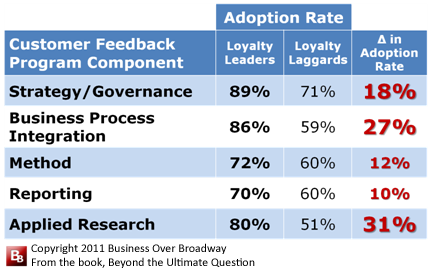
Table 1. Adoption Rates of Customer Feedback Program Practices of Loyalty Leaders and Loyalty Laggards

Continua a leggere “Customer Experience Management: una overview”

Business Linkage Analysis: di cosa si tratta?

NOTA AICEX: la Business Linkage Analysis consente di combinare differenti sorgenti di dat i per scoprire importanti relazioni tra le diverse variabili coinvolte. Vediamo come funziona con le metriche di customer feedback.

Customer feedback professionals are asked to demonstrate the value of their customer feedback programs. They are asked: Does the customer feedback program measure attitudes that are related to real customer behavior? How do we set operational goals to ensure we maximize customer satisfaction? Are the customer feedback metrics predictive of our future financial performance and business growth? Do customers who report higher loyalty spend more than customers who report lower levels of loyalty? To answer these questions, companies look to a process called business linkage analysis.

Voc operational linkage effect

Business Linkage Analysis is the process of combining different sources of data (e.g., customer, employee, partner, financial, and operational) to uncover important relationships among important variables (e.g., call handle time and customer satisfaction). For our context, linkage analysis will refer to the linking of other data sources to customer feedback metrics (e.g., customer satisfaction, customer loyalty).

Continua a leggere “Business Linkage Analysis: di cosa si tratta?”

Mantenere una promessa vale ben di più che eccedere le aspettative

NOTA AICEX: secondo recenti studi, eccedere nel mantenere una promessa non ha un valore superiore per il cliente. Mantenerla è già sufficiente per ottenere la sua fedeltà.

Promise

You better think twice before breaking that promise — or exceeding it.

New research from the University of Chicago Booth School of Business finds that exceeding a promise isn’t viewed any more highly than keeping a promise.

“I think there are two implications to keep in mind, both in our professional and personal lives. First, maintaining good relations with other people does not require a superhuman effort. Do what you promise you’ll do, and people are grateful,” says Nicholas Epley, John Templeton Keller Professor of Behavioral Science at Chicago Booth. “You don’t need to be Superman and go above and beyond your promises in order to be appreciated by other people.

“Second, if you do put in the superhuman effort to do more than you promised, don’t get angry when other people don’t seem to appreciate the extra work you put in. They’re not inherently ungrateful or unappreciative — they’re only human.”

Continua a leggere “Mantenere una promessa vale ben di più che eccedere le aspettative”

Come perdere un cliente in 10 giorni

NOTA AICEX: la maggior parte delle aziende stanno, consciamente o meno, sabotando le loro relazioni con i clienti. Questi ultimi sono esacerbati e stanchi di sopportare e vogliono essere certi che i loro amici sappiano tutto.

3462376323_e55120ea0a

After the popular post I wrote titled 19 Signs Customers Are Just Not That Into You, which sounded an awful lot like the romantic comedy, He’s Just Not That Into You, I was inspired by the title of another rom-com, How to Lose a Guy in 10 Days, for today’s post.

When we engage with customers (or, when they engage with us), we are (hopefully) engaging for the long-term, developing a relationship. Some folks question the use of the term “relationship,” but let’s just use Merriam-Webster’s definition: the way in which two or more people, groups, countries, etc., talk to, behave toward, and deal with each other; the way in which two or more people or things are connected.

That connection is what I’m referring to. We want to connect with our customers, not just transact with them. Relationships take time and work, every day; the focus and the desire to keep the relationship alive and strong should never stop because, when it does, the relationship will end. The connection is gone.

My 19 Signs post was more about how customers were not showing their love to brands anymore. In this post, the focus is on companies and the things they are knowingly or unknowingly doing to sabotage their customer relationships..

Continua a leggere “Come perdere un cliente in 10 giorni”