
Un briciolo di Customer Experience avrebbe evitato la figuraccia degli Oscar

[Photo: Eddy Chen/ABC/Getty Images]

AICEX: Replichiamo un post pubblicato su fastcodesign.com secondo cui la figuraccia la notte degli Oscar è dovuta al fatto che i cartoncini dove sono scritti i vincitori non hanno un titolo adeguato. Alla fine di questo post trovate una proposta di modifica del cartoncino. Considerando Warren Beatty come un cliente una semplice Customer Journey o un banale test di User Experience avrebbe fatto emergere l’anomalia. O forse no? 🙂

Anyone who watched the Academy Awards live could tell something was wrong. Warren Beatty looked at the card, which supposedly held the winner for Best Picture. And then he looked again. He could clearly tell something was amiss, but he couldn’t put his finger on what.

Then he showed it to Faye Dunaway who took the fall on his behalf. She announced La La Land for Best Picture. As we know now, she was reading the Best Actress card, which had both Emma Stone and La La Land listed.

The winner was actually Moonlight—printed on a card hiding somewhere backstage.

UPDATE: Read our follow-up post, which fixes the design, here.
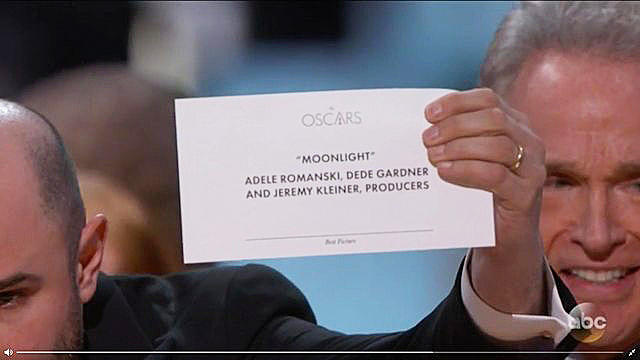
[Screenshot: via Reddit]

Of course, this was an operational SNAFU. The most important moment of the night was ruined because Beatty was given the wrong card. But it could have been easily avoided by good design, argues Redditor ShinyTile. And it’s true.

The winning cards at the Academy Awards are layer upon layer of bad typographic design. For one, the Oscars logo is the biggest thing on the card. Which would only make sense if the announcer were blindfolded, stuck in a trunk, and dropped onto one of many stages at many award shows, and he didn’t know which one until he opened the envelope.

VIDEO: HERE’S EVERYTHING WE LOVED (AND HATED) ABOUT THOSE MEMORABLE OSCARS

Right below “The Oscars,” the winner is listed centered and in quotes. This decision makes some sense. Positionally, to make a word center-aligned makes it obvious and important—like the title of a book. But why isn’t this winner big or in any way bolded? Why isn’t the type presented to be more important through its weight or size than all the names listed below it—even just for pure legibility under the stage lights?

Finally, the card’s category label is in fine print. Best Picture or Best Actress is barely visible—tiny, italicized, and of a finer weight. Of course, that doesn’t matter when everything goes right. But the role of design isn’t to be a solution for when things so often go right, but for when things so often go wrong—which is, as it happens, exactly what happened last night.

“Just make “Best Picture” and “Moonlight” in huge text. That’s it,” writes ShinyTile. Exactly. It’s really that simple.

UPDATE: One designer re-worked the card to solve this issue. Check out his simple, clever solution.

SOURCE: https://www.fastcodesign.com/3068535/this-simple-design-change-would-have-saved-the-oscars

NOTA AICEX: Cliccando QUI vedete come potrebbero modificarsi i cartoncini, evitando l’invisibile titolo in basso “Best Picture” e mettendolo bello grande in alto.


Forbes: la Customer Experience serve per far star bene i clienti, non le aziende!


AICEX: Tanto per evitare incomprensioni, se i Clienti stanno bene quasi certamente stanno bene anche le Aziende di cui sono clienti! : )   

Photo: Shutterstock – Author: Micah Solomon,  Forbes Contributor

A great customer experience is one where customers feel good, even look good, during their time spent doing business. So, it’s important that a business invest in whatever will improve a customer’s feelings and self-esteem.

I was recently reminded of  this customer experience principle in, of all places, the bathroom. To be specific, it came to me while I was standing in front of my bathroom mirror at the gorgeous Old Edwards Inn, a luxury resort in Highlands, NC. (No, this isn’t how I always travel, I’m afraid. I was there for work. But I didn’t enjoy it any less.)

The version of my face that I saw smiling back at me had a healthy glow and an almost halo-lit appearance.  Optimistically, if preposterously, I was tempted to attribute this to my brief time in the North Carolina mountain air.  Whatever the source, looking good was an immediate boost to my spirits, particularly since I was slated to step onstage within the half hour.

Continua a leggere “Forbes: la Customer Experience serve per far star bene i clienti, non le aziende!”

La Customer Experience è il nuovo “Prodotto” da vendere ai clienti

AICEX: In effetti è sempre un tema di “Servitization”. Del resto con la Realtà Virtuale/Aumentata etc.. non offriamo forse delle “semplici” Esperienze?

This is the time when the consumer rules the world, right? The time when our experiences are seamless. The time when the companies we do business with have it all figured out. Right? Not quite.

Doesn’t it feel great when you have an amazing experience with a company? Doesn’t everyone love Amazon? Every time we have one of these, we wonder why there aren’t more of them. The technology exists to make these delightful experiences possible. The promise of a world where interacting with a company is a happy experience is exciting. We still have a ways to go, but there is hope.

As our friends at Servion point out in their blog, Gartner predicts, “during the next three years, 60% of digital commerce analytics investments will be spent on customer journey analytics.” Companies are finally putting emphasis on this critical capability and the resulting journey improvements cannot come soon enough for consumers.

Continua a leggere “La Customer Experience è il nuovo “Prodotto” da vendere ai clienti”

I Brand sono come le persone, ce ne sono tanti!

emotions-customer-experience

AICEX: Le Emozioni ci consentono di capire perchè si sceglie un Brand piuttosto che un altro. E fanno la differenza nel caso di prodotti e servizi soggetti a “commoditization”.

Brands are like people – there are many of them.

Just like people, few are liked or trusted. And among those, even fewer are able to transcend emotional barriers. So just like successful people – successful brands are able to capitalize on different customer motivators and cater directly to them.

These motivators can include the desire to “be different”, “caring about the environment”, or “enjoying a sense of stability”. Identifying the right motivator may be difficult – because not only do these connections have to be created, customers themselves may not be consciously aware of them.

Reaching emotional connections in the customer experience

Millenials and Generation Z consumers place their feelings at the forefront during purchase decisions, more so than consumers of previous generations. In fact, all types of brands – from cat food to SaaS software are able to capitalize on this new type of consumer, transferring emotional connections to the customer experience.

So when a brand promises us to stand out from the crowd, offers to bring order and predictability to our lives – these triggers could make us gravitate towards that brand.

One way of pinpointing these triggers is to understand customer personas. For example, Jack, 30 is tech-savvy and is able to start using a product after watching one or two video tutorials. Mary, 50 prefers to talk with a person over a screen-sharing session instead. Understanding customer personas is the first step to understanding inner drivers that shape our decision making process.

The seconds step is to group customers according to their value system:

  • Do they seek to be different vs. belong to a group?
  • Do they want to experience freedom vs. to feel in control?
  • Do they enjoy a sense of thrill vs. tranquility?
  • Do they care about the environment vs. themselves?
  • Do they consider a successful life as a result of risk taking vs. security?

Sharing customer knowledge across departments, taking notes during customer interactions and using customer community tools during the customer journey is a fool-proof way to increase customer value and maximize ROI with minimal risk.

A study by HBR revealed that emotionally connected customers are 25-100% more valuable than just highly satisfied customers. Not all brands are able to connect their strong brand images to strong emotional connections:

customer-expectations

Continua a leggere “I Brand sono come le persone, ce ne sono tanti!”