Il futuro del Retail Checkout: no Checkout oppure fantascienza?

NOTA AICEX: Presto arriveremo a non pagare alla cassa ?

Reuters

“People have said when checkout is working really well, it will feel like stealing. You grab a pair of shoes and you just walk out.” That’s how Michael Chui, a partner at the McKinsey Global Institute,describes the retail-checkout experience in your not-too-distant future.

This coming transformation in the way you pay for items in bricks-and-mortar stores will occur through a network of sensors placed strategically around stores, which will enable retailers to recognize you (through your smartphone or other devices) when you walk through the door. Inexpensive sensors also will be attached to (or embedded in) items available for purchase. And the stores will already have your preferred payment information on file, so when you exit the store with your chosen merchandise, you’ll simply be billed automatically, totally skipping any traditional checkout experience.

Many restaurants are already in the vanguard of transforming the checkout experience. As Alexis Madrigal explained two years ago here, a growing number of restaurants are using iPads or other tablets to have diners place their own orders and then check themselves out at the end of the meal. If such a change becomes widespread, as Madrigal pointed out, the implications for waitstaff employment will be profound. Continua a leggere “Il futuro del Retail Checkout: no Checkout oppure fantascienza?”

La sfida del Customer Lifetime Value

Nota Aicex: l’era digitale multi canale porta spesso i brand a non calcolare correttamente il Customer Lifetime Value. Vediamo perché.

What is hampering your ability to increase customer lifetime value

Working in silos and managing multichannel are stopping brands from realising the full value of a customer over time.

The multichannel digital age and the siloed nature of organisations are hindering brands and companies from calculating one of the key measures of success – the lifetime value of a customer.

Customer lifetime value (CLV) is the total worth of a customer to a business over the entirety of the relationship. But with the various ways that consumers can engage with brands, from social media to call centres, the barriers to measuring and acting on that value are proving a challenge.

Lezioni di Customer Experience da un addetto alle pulizie

Dopo che un Barbiere ed un Tassista ci hanno insegnato qualcosa sulla Customer Experience, vediamo cosa ha da insegnarci un addetto alle pulizie.


clean

In business it goes without saying that people buy people but I’m going to say it anyway because it’s true. People do indeed buy people. Before I was able to dedicate my full time to being an entrepreneur I had to take up all kinds of jobs to ensure I had a stream of income to keep a roof over my head as well as feed and clothe myself. I am highlighting the work of a cleaner because it is one of the most toughest jobs you can do. It is physically demanding, you need attention to detail and you must have excellent customer skills to do it well. There are not many out there who can do all three at once. I believe being a cleaner gives an extremely unique perspective to the importance of customer service because the environment you’re working in is very intimate. When you’re working in someone’s home you’re in a way invading their privacy although at their request. So here are three brilliant skills I developed from being a cleaner that are equally useful for your customer services.


Continua a leggere “Lezioni di Customer Experience da un addetto alle pulizie”

Customer Experience Management: una overview

Customer Experience Management Program Components

Customer Experience Management (CEM) is the process of understanding and managing your customers’ interactions with and perceptions of your company or brand. The ultimate goal of CEM is to build valuable relationship with customers so they stay with you longer, advocate on your behalf and expand their relationship with you over time.

A CEM program consists of a set of organized actions that support the goal of CEM. While a CEM program has many moving parts, an easy way to organize those pieces is depicted in the figure on the right. A CEM program has six major components:

  1. Strategy addresses how companies incorporate CEM into their long-term plans to help achieve its objectives and goals
  2. Governance describes the formal policy around the CEM program: Rules, Roles, Requests
  3. Business Process Integration involves embedding CEM processes/data into other business operations
  4. Method addresses the means by which customer feedback is collected
  5. Reporting addresses analysis, synthesis and dissemination of customer feedback
  6. Research is concerned with how companies provide additional customer insight by conducting deep dive research using different types of customer data

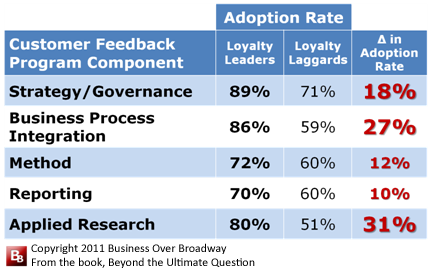
Table 1. Adoption Rates of Customer Feedback Program Practices of Loyalty Leaders and Loyalty Laggards

Continua a leggere “Customer Experience Management: una overview”