
Customer Experience Management: una overview

Customer Experience Management Program Components

Customer Experience Management (CEM) is the process of understanding and managing your customers’ interactions with and perceptions of your company or brand. The ultimate goal of CEM is to build valuable relationship with customers so they stay with you longer, advocate on your behalf and expand their relationship with you over time.

A CEM program consists of a set of organized actions that support the goal of CEM. While a CEM program has many moving parts, an easy way to organize those pieces is depicted in the figure on the right. A CEM program has six major components:

  1. Strategy addresses how companies incorporate CEM into their long-term plans to help achieve its objectives and goals
  2. Governance describes the formal policy around the CEM program: Rules, Roles, Requests
  3. Business Process Integration involves embedding CEM processes/data into other business operations
  4. Method addresses the means by which customer feedback is collected
  5. Reporting addresses analysis, synthesis and dissemination of customer feedback
  6. Research is concerned with how companies provide additional customer insight by conducting deep dive research using different types of customer data
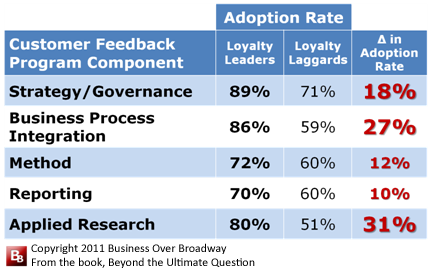
Table 1. Adoption Rates of Customer Feedback Program Practices of Loyalty Leaders and Loyalty Laggards

Continua a leggere “Customer Experience Management: una overview” →

Cos’é la Customer Experience?

NOTA AICEX: siamo indubbiamente nella Age of the Customer. Ma sappiamo davvero cos’è la Customer Experience?
I don’t know of any business I have ever consulted that didn’t want its customers to be happy. Going above and beyond, and leveraging both social media and email for a great conversation about and understanding of customer expectations. But as Jim Basingame pointed out in a brilliant Forbes post this past January, businesses of every size have to elevate their game even more. They now operate in an environment (whether they know it or not) where customers rule:
“Visionary Sellers that transition to the new Age with their customers will be successful by recognizing that being competitive is no longer enough—you also have to be relevant.”

Continua a leggere “Cos’é la Customer Experience?” →

Gli smartphone stanno deteriorando l’esperienza nei ristoranti?

Did you need three minutes to take this photo?.
Did you need three minutes to take this photo?

Photo courtesy Chris Waits/Flickr

Your smartphone is the scourge of restaurants. Customers snapping photos of food and dawdling on Facebook at meals have slowed down table service by an hour over the last 10 years, as an anonymous post on Craigslist’s “rants & raves” section recently alleged. The writer claimed that his restaurant, located in Manhattan’s Midtown East and serving “both locals and tourists,” had studied security footage from July 2004 and compared with a tape of a recent Thursday this month. The takeaway: Today’s technologically distracted diners take longer to order, longer to eat, and longer to pay—and then they blame the restaurant for the wait! “We are grateful for everyone who comes into our restaurant,” the aggrieved restaurateur wrote, “but can you please be a bit more considerate?”

Continua a leggere “Gli smartphone stanno deteriorando l’esperienza nei ristoranti?” →

Come misurare al meglio la felicità dei clienti

NOTA AICEX: l’indicatore NPS è ampiamente utilizzato da tante aziende per misurare la soddisfazione dei loro clienti. Ci ricordiamo ancora i vecchi metodi? 

Customer service was simpler in the era before big box chains and online shopping. Back then, to delight his clients, a business owner simply needed to offer fair prices, convenient hours and honest advice. To really make an impression, he might deliver a customer’s purchases to his home or ask the shopper about her children. He probably knew most of the families he served.

Best of all, business owners had an excellent, instant measure of success: A customer’s smiling face.

Many transactions today involve very little human contact. Consumers can buy just about anything they want on their phones (after browsing online reviews and price comparison sites first, of course) while waiting in line for their morning coffee. And if a customer doesn’t like her latte, she may just dash off a complaint to the store’s Twitter feed instead of telling the barista. Or when shopping, if she’s not sure how a dress fits, rather than seeking honest advice from a sales clerk, she might post a photo on Instagram to get input from her friends.

Continua a leggere “Come misurare al meglio la felicità dei clienti” →